


In power systems, bird activity does indeed cause considerable trouble. They often build nests on utility poles or transmission towers, and sometimes collide directly with high-voltage lines. These behaviors not only threaten the birds' own safety but can also trigger grid failures and even cause power outages.
Currently, for the issue of birds colliding with power lines, Shenzhen Zhenquniao Technology's ZQN-DL-DP High-Voltage Line Bird Deterrent Tag is a relatively common protective device. Its principle is straightforward: it uses reflective surfaces and dynamic rotation to alert birds to avoid power lines. The diamond-shaped reflective stickers on the bird deterrent tags emit intense reflections when exposed to sunlight or artificial light. Birds' eyes are highly sensitive to this flickering light, causing them to instinctively avoid it and thereby reducing collision risks. Additionally, the reflective stickers are coated with a waterproof and UV-resistant layer, ensuring long-term outdoor durability without aging or degradation.
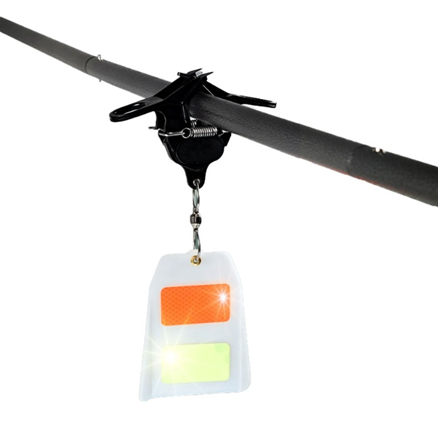
In addition to reflecting light, the bird-repelling tags also rotate in the wind. They begin spinning in winds of 2-3 on the Beaufort scale, and this continuous rotation alerts birds to their presence. The 360-degree flashing light generated during rotation further enhances the warning effect, enabling birds to detect high-voltage lines in advance and avoid collisions. This protects birds while reducing the likelihood of power grid failures.
In terms of installation, the high-voltage wire bird deterrent tag features a reinforced spring clip design that securely fastens to wires of varying thicknesses, ensuring it remains firmly attached even during high winds. This design guarantees the device's stability while facilitating easy maintenance and replacement, offering significant convenience.

In short, bird prevention on power grids is fundamentally tied to both electrical safety and ecological conservation. Simple devices like bird deterrent tags effectively reduce the risk of bird collisions through reflection and rotation. These solutions are both economical and practical, helping to mitigate bird-power-line conflicts.


